Jerusalem Police
Here There Is No WhyThe Jerusalem police function in the novel as both an investigative institution and a mechanism for controlling which versions of violence become official knowledge. Their handling of Chaim Lerner’s death initially ratifies suicide and closes the case, but the same unresolved file later becomes the basis for Charlie’s covert investigation with Judah Loeb. By the end, the police embody a painful contradiction: they seek the truth about a killing, yet their senior officer accepts concealment when exposing it might damage a fragile peace process.
Institutional Role and the Lerner Case
The Jerusalem police had kept the Lerner file open for twenty years, a fact Charlie revealed when Judah first considered writing about Chaim Lerner. The continued existence of the file made the subject attractive to Judah’s editors and suggested that the official story had never entirely settled the matter. Yet an open file did not mean an active investigation. Because Chaim’s death had been treated as suicide, the police had conducted almost no interviews at the time and had effectively declared the case closed.
The original inquiry nevertheless collected material that later acquired new significance. Officers questioned the family about their whereabouts, and Michal and Zehava Lerner supplied an alibi supported by a dated, timed receipt from Rafik’s Boutique in the Jerusalem Old City. The police also interviewed the shopkeeper, Rafik Salahmi. Documentary evidence preserved in the file included Chaim’s calendar, his handwritten statement on the Lebanon War, and receipts. The archive therefore contains both the remains of an investigation and the evidence of how narrowly that investigation was framed.
The physical scene exposes the limitations of the official conclusion. At the Lerner house, Hannah Loeb studies the third-story balcony and slowly runs her fingers over its dark metal railing. The railing consists of four rusting bars, approximately neck-high to a medium-height man. Judah initially considers the climb difficult but possible, while Hannah argues that Chaim’s injured knee made a voluntary jump implausible. The balcony thus turns the police conclusion into a question of bodily movement, height, injury, and force rather than merely motive.
Charlie’s Covert Investigation
Charlie, now a Jerusalem homicide detective, had urged Judah to pursue the case when Judah first contacted him three years earlier. The police connection made the project more commercially attractive, but Charlie’s private motive was stronger: he wanted help finding Chaim’s killer. He promised assistance from his department even though the department had not formally reopened the investigation.
Charlie used Judah as an external investigator because the people connected to the case had become too powerful for an ordinary police inquiry. He explained that Interior Minister Meir Alon could bring down a government by signaling to his faction, while Rabbi Kaplowitz was among the most powerful rabbis in the settlements. Charlie could not simply summon such figures to an interrogation room. He needed the pressure of a foreign journalist, whose questions could create public scrutiny without requiring the police to make an official move.
His method combined old friendship, institutional access, and deliberate deception. Charlie remembered Judah’s stories about Chaim’s enemies, including influential figures from the Kabbalah circle and people Chaim had antagonized at Pisgat David. After speaking with Alon and Rabbi Kaplowitz, Charlie was sufficiently alarmed to bring Judah to Jerusalem, but he lied about the case’s status. The police had not actually reopened it. Charlie had brought Judah in so that an outsider could investigate what the institution itself could not safely or openly pursue.
The detective also shaped Judah’s line of inquiry through misdirection. He directed attention toward ideological hostility and alleged blackmail, presenting Alon and Rabbi Kaplowitz as possible suspects. Charlie later admitted that neither man had planned to meet Chaim that night and that the blackmail theory had been invented. By feeding Judah a conspiratorial explanation without solid proof, he could encourage a book that would appear to be unsupported or prejudicial and therefore make a formal investigation less likely.
Evidence, Alibis, and Political Pressure
Charlie’s reconstruction of the death begins with testimony from five neighbors. They heard the body fall at precisely nineteen hundred hours, a heavy thump like a load of flour hitting pavement. Immediately beforehand, they heard someone say, “Whoops,” in Chaim’s voice, as though he had dropped something. The witnesses agreed on the time, and two witnesses placed Michal and Zehava away from the apartment. On the strength of those accounts, Charlie initially removed Chaim’s family from consideration and asked who remained.
The case also demonstrates how an apparently secure alibi can conceal as much as it proves. Michal said she had been shopping for a wedding dress with her future mother-in-law and had taken the dress home that night. The receipt from Rafik’s Boutique recorded the date and time, and the shopkeeper’s interview appeared to support her account. The police had therefore not ignored the case entirely; they had gathered corroborating evidence. But the later investigation shows that documentary verification did not exhaust the meaning of the event, especially when family members had reasons to protect one another and themselves.
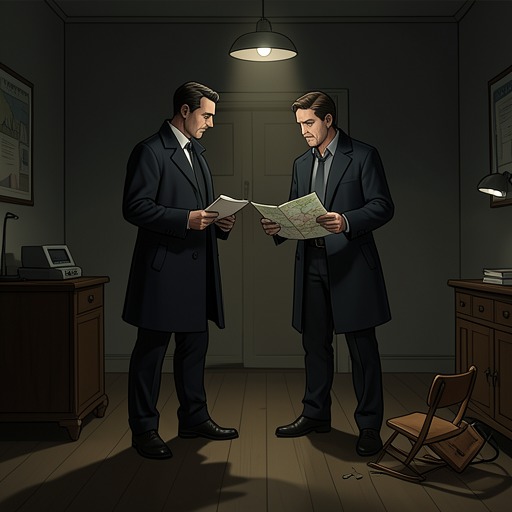
Charlie’s questioning of Meir Alon illustrates the coercive authority available to the police even when the institution is not formally prosecuting anyone. Three days after a terrorist incident, Charlie interviewed Alon at six in the morning in an empty office at police headquarters in the Russian Compound. He chose the hour because there would be fewer witnesses and because he believed early morning was the best time to catch someone in a lie. The room had a single uncovered bulb, no windows, no books, plants, or portraits, and Charlie offered neither tea nor water. The setting stripped the interview of ordinary political ceremony and replaced it with controlled institutional pressure.
Yet the police are also constrained by hierarchy and power. When Charlie’s investigation points toward Zehava, he does not pursue prosecution. Zehava has become a leading figure in Israel’s political opposition through her eloquence and activism during the Second Intifada, and she is widely viewed as a possible future prime minister. More importantly, she is negotiating with the Palestinian Authority and claims to be on the verge of a historic permanent settlement. Her political importance transforms an old homicide into a question of national consequence.
Truth, Concealment, and the Peace Process
Zehava admits to Judah that she wrestled Chaim from the balcony and killed him, while insisting that she acted in self-defense. She fears that the police would not believe her account because Chaim was infirm and she was stronger. Even if acquitted, she says, she would remain the person who killed “Saint Auschwitz,” and her political career would end. Her ambition is presented not merely as personal advancement but as an ambition attached to the country’s future.
Charlie confirms that Zehava lied to Judah from the beginning and that she did kill Chaim, but he accepts her claim of self-defense. His judgment rests partly on his knowledge that Chaim was not the saintly public author of his reputation and could be cruel and violent toward those closest to him. It also rests on political calculation. Zehava, in Charlie’s view, is essential to a peace process that has suddenly become possible; damaging her reputation might destroy not only her career but the larger hope of peace between Israel and its neighbors.
The police consequently become guardians of a negotiated silence. Charlie tells Judah that no one will support the truth publicly: not Michal, not Rafik Salahmi, not Rafik’s wife, and not Charlie himself. The institutional imbalance favors the celebrated politician over the foreign journalist, while the moral vocabulary of peace is used to postpone criminal accountability. The question is not whether the police possess enough information to suspect the truth, but whether truth should be made public when its disclosure could alter political history.
Judah recognizes the manipulation. He understands that Charlie’s invented theories about radical ideology and blackmail were intended to produce an unusable story, one that could be dismissed as unsupported American hostility toward Israel. Charlie had claimed to need evidence to justify reopening the investigation, but Judah realizes that his real objective was to prevent pressure to investigate Zehava. The police thus operate through both investigation and disinformation: the detective searches for the killer while constructing a narrative that protects the killer from official exposure.
Institutional Aftermath and Narrative Significance
Judah accepts Charlie’s deal. He writes his book about Chaim but leaves the death unresolved, offering suicide, illness, trauma, loneliness, accident, or conspiracy as speculative possibilities. The published book restores his journalism career, eventually leading him to the Washington Post, while the decisive fact remains concealed. The police have therefore influenced not only the legal record but also the literary record: their silence helps determine what the public is permitted to read as fact.
The peace negotiations that justified concealment never become a settlement. Zehava and her team hold one round of secret meetings with Palestinian negotiators in London, with Charlie arranging Judah’s attendance on the condition that he delay reporting and avoid direct quotations. The parties exchange maps, with Israel offering approximately 95 percent of the West Bank and the Palestinians demanding the whole territory with limited border adjustments. Pisgat David appears on the Palestinian side of both versions. The talks initially seem promising, but disputes over Jerusalem, Palestinian refugees’ right of return, recognition of Israel as a Jewish state, the connection between Gaza and the West Bank, and Hamas soon make agreement impossible.
The collapse exposes the cost of the police decision. The truth about Chaim’s death was suppressed in the name of a peace process that dissolved a week after the London meetings. The continuing conflict, terrorist attacks, Israeli military responses, and new settlements make the bargain look less like a successful exchange of justice for peace than a postponement whose promised result never arrived.
Charlie’s final fate completes the institution’s tragic arc. A terrorist bomb outside the Russian Compound kills the head of the Israel police homicide division, Judah’s friend Charlie. The officer who manipulated an investigation to protect a political possibility is ultimately claimed by the violence that the police continually confront. His death does not resolve the contradiction between law and political necessity; instead, it leaves the unresolved case, the concealed confession, and the failed peace process as parallel reminders that official closure can outlast neither memory nor history.